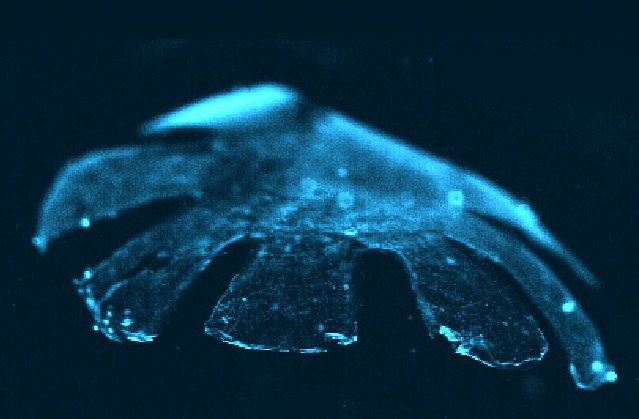
In the sciences as well as in design, biomimicry has begun to exert a significant influence on ongoing research endeavors. Not only do these activities involve the close study and emulation of life, but they also often involve the use of living organisms as materials. We would therefore classify this particular kind of experiment as a hybrid approach—part mimicry, part utilization—both a study of nature and an active exploration of it.A good example is the recent development of a “synthetic jellyfish” at Harvard University and the California Institute of Technology. The project is both a study of the mysterious workings of jellyfish and an experiment in pairing synthetic and natural substances. When researchers failed in their first attempt to emulate the swimming movements of the medusa jellyfish when they combined plastic film with muscle tissue, they realized the complex nature of their material engineering problem. In their words, they learned that “successful medusoid designs must therefore match muscle stress generation with substrate compliance.”
After modifying the plastic film with slits, which added flexibility to the polymer layer, the jellyfish hybrid worked, they report in a paper on “tissue-engineered jellyfish with biomimetic propulsion” in Nature Biotechnology. The scientists watched their creation swim through a water tank, its biomechanical muscles activated by electrodes. Although this successful experiment sought to reenact only one of the myriad complex activities of a single organism, it reveals the multifaceted nature of biomimetic research using hybrid materials—incorporating biology, engineering, materials science, and design.